
Arm sleeves for running without buying the wrong pair
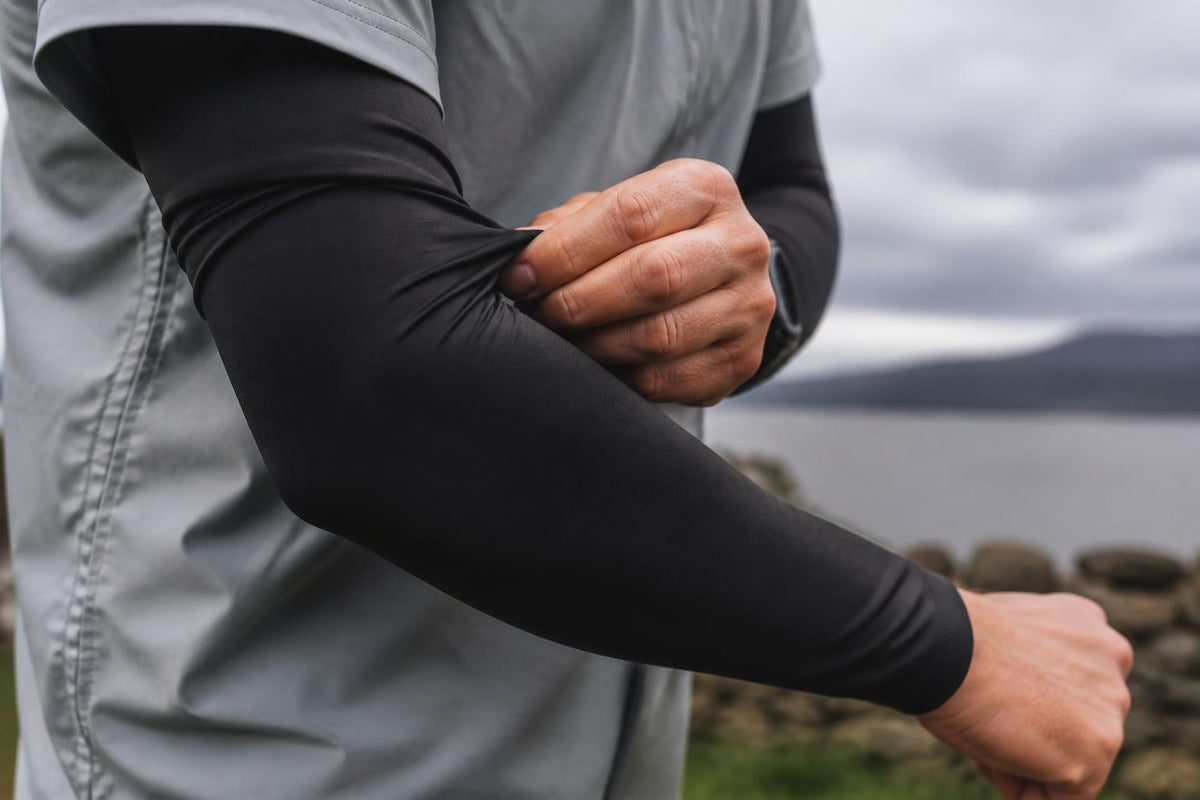
If you are deciding whether arm sleeves are worth it for ordinary UK running, the short answer is yes, when you want flexible warmth without committing to a full extra layer. A good pair keeps the chill off on cool starts, deals well with stop-start weather, and gives you something easy to remove and stash once you have warmed up.
The trick is not to buy them as if they were a miracle bit of race kit. For most of us, arm sleeves are simply a practical layering tool. Get the fit right, ignore overblown claims, and they can be one of the most useful small items in your running drawer, especially in a British spring or autumn when one run can begin cold, turn mild, and finish breezy.
What arm sleeves actually do on an ordinary run
On an ordinary run, arm sleeves do three simple jobs well.
First, they add light warmth where many runners feel the cold early on, across the forearms and upper arms. That matters on cool mornings when a short-sleeve top feels a bit exposed, but a full long-sleeve top feels like too much after ten minutes. Sleeves let you bridge that gap neatly.
Second, they make layering easier in changeable weather. In much of the UK, the issue is not deep winter cold every day. It is the in-between stuff, a fresh start, a bit of breeze on open paths, a rise in temperature once the sun comes out, or a run that begins under cloud and ends brighter. In those conditions, arm sleeves are often more useful than a fixed extra layer because you can pull them on at the start, roll them down, or remove them completely and pocket them.
Third, they can add a bit of coverage without bulk. Some runners like that for exposed routes, drizzly conditions, or simply to avoid the clammy feel of bare arms in a cool wind. That is not about turning a run into a technical exercise. It is about being comfortable enough not to think about your kit.
That is why we tend to think of running arm sleeves as a day-to-day item rather than something reserved for events. They suit the runner who goes out before work, joins a social run after work, or heads out at the weekend when the forecast is vague and the actual weather could still go either way.
There are other claimed benefits you will see mentioned, such as compression, improved circulation, and faster recovery. It is fair to say the evidence is mixed, and the effect people feel can vary. Some runners genuinely like the more held-in feel through the forearm and biceps. Others just want light warmth and a soft fabric that stays put. We would buy on the practical benefits first and treat the bigger performance promises cautiously unless a specific product gives clear, credible detail.
When arm sleeves make more sense than a long-sleeve top
The easiest way to choose is to think about what problem you are trying to solve.
If your main issue is a cool start that usually turns comfortable after the first mile or two, sleeves often make more sense than a long-sleeve top. They warm the arms without adding another full torso layer, which is where many runners overheat first. If you already know you are comfortable in a short-sleeve top through the body, sleeves can be the tidier solution.
If the weather is consistently cool from start to finish, a long-sleeve top or a light base layer can be the better call. That is especially true when the chill is not just on your arms, but across your chest and back as well. Arm sleeves cannot replace proper torso insulation. They work best when you only need a modest adjustment.
If it is windy or there is light drizzle, sleeves can still be useful, but think about exposure. On a sheltered park loop, they may be enough. On open roads, canal paths, or coastal routes, a light top or jacket may do more to keep you comfortable overall. Wind across the chest can make you feel cold long before your arms do.
For many UK runners, the most common comparisons look like this:
Short-sleeve top plus sleeves: best for variable conditions, cool starts, and runs where you expect to warm up quickly.
Long-sleeve top alone: best for steady cool weather when you want a simple one-piece solution and do not expect to remove layers.
Short-sleeve top plus light jacket: best for wind, drizzle, or colder conditions where you need some protection for the body as well as the arms.
Base layer under a top: best for properly cold runs, especially in winter, when you want close-fitting warmth throughout rather than something removable.
That last point matters. A base layer and arm sleeves are not direct substitutes. A base layer is part of a full system, sitting close to the skin across the torso and arms. Sleeves are a modular extra. If you are often cold through the whole upper body, start with the base layer, not with sleeves.
There is also the question of convenience. Sleeves are easier to take off mid-run than a top, and far easier than a jacket if you do not want to tie anything round your waist. That makes them handy for social runs where the pace is gentle at first, then picks up, or for morning runs where the temperature climbs quickly.
If you are building out a practical kit cupboard rather than buying one item for every condition, sleeves sit well alongside running and training clothing because they fill a very specific gap. They do not replace everything else. They stop you having to guess wrong between too little and too much.
How running arm sleeves should fit
Fit is what decides whether sleeves feel useful or annoying.
At the wrist, they should sit close without cutting in. You want enough contact that the fabric does not flap or ride upward, but not so much pressure that you notice a tight band every time you bend your hand. A good wrist fit feels secure and quickly disappears from your attention.
Through the forearm, the sleeve should feel smooth and lightly supportive. There should be no loose folds, but also no sense that the fabric is digging in. If you get deep marks on the skin straight away, or your hands start feeling cold, tingly, or slightly numb, the pair is too tight. Compression in sportswear is often overstated, but basic circulation still matters. Secure is good. Restrictive is not.
Around the elbow, movement is the test. You should be able to bend and straighten the arm naturally without the sleeve bunching heavily or dragging downward. A little creasing is normal because elbows move a lot. What you do not want is a sleeve that forms a thick fold at the front of the elbow or one that starts slipping every time your arm swings.
At the upper arm, the top edge needs to stay in place without pinching. This is where many poor fits show themselves. Too loose, and the sleeve gradually works its way down. Too tight, and you spend the run aware of a band biting into the biceps. If there is a gripper, it should help hold position rather than doing all the work because the sleeve shape is wrong.
A few clear signs tell you a pair is too loose:
- you keep tugging them back up
- the wrist area gapes
- the fabric twists as you run
- they bunch around the elbow
And a few signs tell you they are too tight:
- obvious pressure marks after a short wear
- discomfort at the top band
- tingling, cold hands, or forearm fatigue unrelated to the run
- reluctance to keep them on once you warm up, not because of temperature, but because they feel intrusive
If you are between sizes, think about your goal. For light warmth and comfort, the less aggressive fit is often better. For a firmer, more compressive feel, some runners prefer the closer option, but only if it still allows normal movement and does not create pressure points.
This is one area where it helps to buy from a specialist range rather than treating sleeves as an afterthought. If you want to compare options, our selection of arm sleeves for running is organised for exactly that kind of practical choice.
Which features are worth paying attention to
The best buying points are not usually the loudest ones on the packaging.
Fabric feel matters more than many people expect. Sleeves sit directly on moving skin, often for the whole run, so scratchy fibres or a plasticky finish become irritating quickly. A soft, smooth knit with decent stretch is usually the safest bet for recreational running. If you are sensitive to overheating, pay attention to whether the fabric feels airy and light rather than dense.
Seams are worth checking. Flat or low-profile seams tend to be more comfortable, especially if you run in repetitive arm swing for an hour or more. Bulky seams near the wrist or inside the elbow can become noticeable faster than you might think.
Grip at the upper arm can be useful, but it should be sensible. A light silicone or similar gripper can help prevent slipping. Too aggressive, and it can irritate the skin, especially if you sweat a lot or wear the sleeves for longer periods. Good patterning and sizing should do most of the job, with grip as backup.
Packability is one of the real strengths of sleeves. They should fold or scrunch small enough to fit into a pocket, waistband, or vest storage without fuss. If a pair is thick and awkward to stash, it loses one of the main reasons to choose sleeves over another layer.
Care is another practical point. Most runners want kit that can be washed easily and dries quickly. Check the care instructions before buying if you dislike hand-wash-only items or delicate handling. For ordinary use, straightforward wash care tends to mean an item gets used more often. As with most technical fabrics, avoid fabric conditioner unless the care label says otherwise, because it can affect moisture handling.
On technical claims, it pays to stay grounded. Terms like compression, thermoregulation, infrared technology, or recovery support appear often. Some brands, including KYMIRA, may explain the mechanism behind their fabrics in more detail than generic sportswear does, and that can be useful. But for everyday buying, we would still ask the same questions first. Does the fabric feel good against the skin? Does it stay up? Does it keep you comfortable in the conditions you actually run in?
UV protection can be relevant in summer, but in the UK it is usually a secondary buying reason rather than the main one. If sun coverage matters to you, look for a product that states it clearly rather than assuming all sleeves offer the same level.
Colour also has a practical side. Lighter colours can feel less intense in sunshine, while darker colours often look neater for year-round use. If you run in poor light, visibility may matter more than colour preference alone, though sleeves are only one part of that picture. Headwear and gloves can be just as useful in rounding out cold-weather comfort, and many runners pair sleeves with caps and headwear for changeable weather depending on season.
How to use arm sleeves through the year
In spring, sleeves come into their own. This is classic stop-start weather, bright one day, sharp the next, and often cooler than it first looks. A short-sleeve top with sleeves gives you flexibility for those mornings when the air feels cold in the shade but mild in the sun. If the run warms up, take them off and pocket them. That is much simpler than wishing you had not worn a full extra top.
In autumn, the same logic applies, but with a bit more dampness and breeze in the mix. Early autumn can still be mild, especially once you get moving, so sleeves help you extend the life of lighter tops without jumping straight into winter kit. Later in the season, they work well as part of a broader layering setup, especially on easy runs where you are outside long enough to notice the temperature dropping.
On cool summer starts, sleeves are useful when the day itself will be warm but the first half hour is not. That is common on early runs, travel runs, or weekend starts where you are out before the air has warmed. Instead of reaching for a long-sleeve top and ending up overdressed, sleeves let you start comfortably and strip back as the morning changes. They can also be handy if you want light arm coverage without feeling fully wrapped up.
In winter, sleeves are less often the main event and more often part of a system. They can sit under or alongside other layers, depending on how cold it is and how you personally run. If you tend to warm up quickly, a short-sleeve top, sleeves, and a light outer layer can be enough for a lot of UK winter running. If you feel the cold more, a proper base layer under a top will usually do more, with sleeves becoming optional rather than essential.
They are also useful at the edges of winter, when conditions are cold enough for gloves and a hat but not necessarily for your heaviest upper-body kit. Many runners end up with a small set of reliable accessories that let them fine-tune comfort without overthinking it. Sleeves fit neatly into that group alongside running gloves for colder starts and other compact items.
What we would not do is treat sleeves as a fix for every cold-weather problem. If you are underdressed through the torso, if the rain is persistent, or if the wind is strong, another layer choice is probably the real answer. Sleeves are best when the question is, "I only need a bit more on my arms."
That is why they suit the Fair Weather Runner approach so well. Not because they are only for perfect conditions, but because they help you handle ordinary, mixed UK weather without turning a simple run into a kit puzzle. At Fleeta Limited, our Field Notes are there to make those decisions easier, whether you are getting back into running, adding a few useful pieces to your weekly setup, or replacing an item that never quite worked.
Choose for comfort, fit, and realistic use. If a pair stays up, feels good, and disappears into the background while you run, you have bought the right one.
Are arm sleeves only for cold weather?
No. They are most useful in cool, changeable conditions when you may want extra coverage at the start and less later. They can be easier to adjust than changing your whole top.
Should running arm sleeves feel tight?
They should feel close and secure, not restrictive. If they dig in, leave marks quickly or make your hands or forearms feel uncomfortable, the fit is likely too tight.
Can I wear arm sleeves with a short-sleeve top?
Yes. That is one of the most practical ways to use them. A short-sleeve top plus arm sleeves can give flexible coverage without committing to a full long-sleeve layer.
Do arm sleeves stop injuries?
Do not assume that. Arm sleeves are best treated as a comfort and layering item unless a manufacturer provides clear evidence for a specific claim.
How do I wash running arm sleeves?
Follow the care label on the product page or garment. In general, gentle washing and avoiding excessive heat helps technical fabrics keep their shape and feel for longer.