
How to choose a running belt for your phone and keys
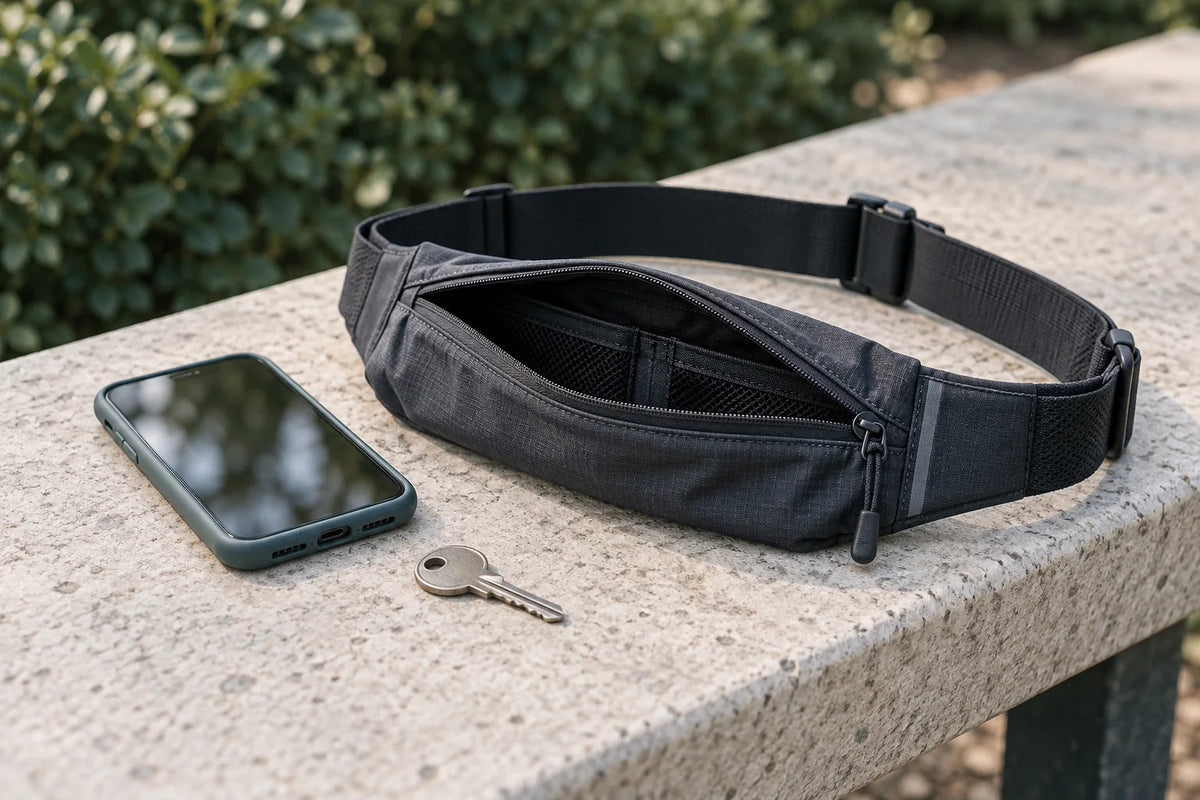
A running belt solves a small, familiar problem: you want your phone and door key with you, but you do not want to carry them in your hand. The useful question is not which belt has the most features. It is whether a particular belt holds your actual belongings comfortably, stays accessible and fits the way you run.
Start with what you already own. A secure pocket in your shorts or leggings may be enough. If it is not, this guide helps you compare a belt with an armband or small running bag, without buying capacity you will never use.
Make a real packing list
Put your usual essentials on a table: phone in its case, the key you need, a travel card and anything else you actually take. If you carry a necessary personal item, include that too. A belt that fits an empty phone is little use if your normal case makes it too bulky.
Separate essentials from things that can wait at home. Taking a full keyring because it is already attached is convenient, but one door key may be easier to accommodate. Keep an appropriate way to contact someone or get home; reducing bulk is not a reason to remove something you need.
The NHS suggests a running armband as one option when you need your phone for Couch to 5K and have no suitable pocket. A belt is another carrying format to consider. Neither is compulsory equipment for becoming a runner. NHS: getting started with Couch to 5K.
Compare dimensions, not just phone-screen sizes
Measure the outside of your phone case, including its height, width and thickness. A description that gives only the maximum screen size does not tell you the usable dimensions of the pocket or its opening. Camera bumps, protective corners and card holders can all affect the fit.
Look for the pocket dimensions and the belt's adjustment range. If these are missing, ask before ordering. Check whether the size refers to your waist, your hips or the position where the manufacturer intends the belt to sit. Measure that point over the clothing you usually wear rather than assuming your trouser size will translate directly.
Choose the format around your routine
A slim pocket belt is worth considering when you carry just a phone and key. A belt with divided storage may be more practical if you want to keep a key separate from a screen. A bottle-carrying design makes sense only when carrying that bottle is part of your plan: check the specified bottle size and whether it is included.
An armband moves the phone away from your waist but changes how you access it. A small pack offers another option when a spare layer or other bulky item is essential. More storage also creates more choices about fit and adjustment. Match the format to the load before comparing colours or extra pockets.
For a short local loop, ask what you need between leaving and returning home. For a run followed by a train journey, include the journey too. The same distance can involve a very different packing list.
Check the loaded fit
Before removing labels or using a new item outside, check the retailer's return conditions and try any permitted fit check indoors. Load the belt with your normal essentials, follow the maker's fitting instructions and adjust it without forcing the closure.
Walk, bend and move your arms. If permitted, a few gentle steps in place can help you notice a buckle that presses, a pocket that catches your arm or an awkward zip. You should be able to move and breathe comfortably. Repeated slipping is a reason to reassess the fit or load, rather than keep tightening indefinitely.
Check how the load sits when you remove one item. A design that feels balanced with a phone inside may sit differently once the phone is in your hand. This is a practical fit check, not a promise that any belt will be completely bounce-free for every person or pace.
Protect and retrieve your belongings
Find out how the key is secured and whether the phone shares that space. A dedicated clip or compartment can be useful, but check how it works rather than assuming a pocket includes one. Practise opening and closing the pocket while standing still. Stop somewhere suitable when you need to use your phone.
Read water-protection wording carefully. Do not assume that a fabric described as water-resistant makes the complete belt or its zip waterproof. Ask what protection the maker specifies, and use an appropriate additional protective case if your belongings need it. Avoid testing a new belt's protection with your phone inside.
Check the forecast before leaving, especially for a longer outing. The Met Office's weather advice is a useful place to review conditions; a storage accessory cannot replace a decision to change the route or timing. Met Office: WeatherReady.
Buy for the run you do most
Before choosing, answer five questions: does your cased phone fit, does the adjustment range suit you, is the key secure, can you reach what you need, and are the care instructions manageable? If an existing pocket already answers those questions, there is no need to add a belt.
For your first organised 5k, use our first parkrun kit checklist to decide what you need to carry before choosing how to carry it.
Sources
- NHS: Get running with Couch to 5K — beginner clothing, phone-carrying and route-planning context.
- Met Office: WeatherReady — checking conditions before an outdoor outing.