
How to choose sports socks for longer, easier runs
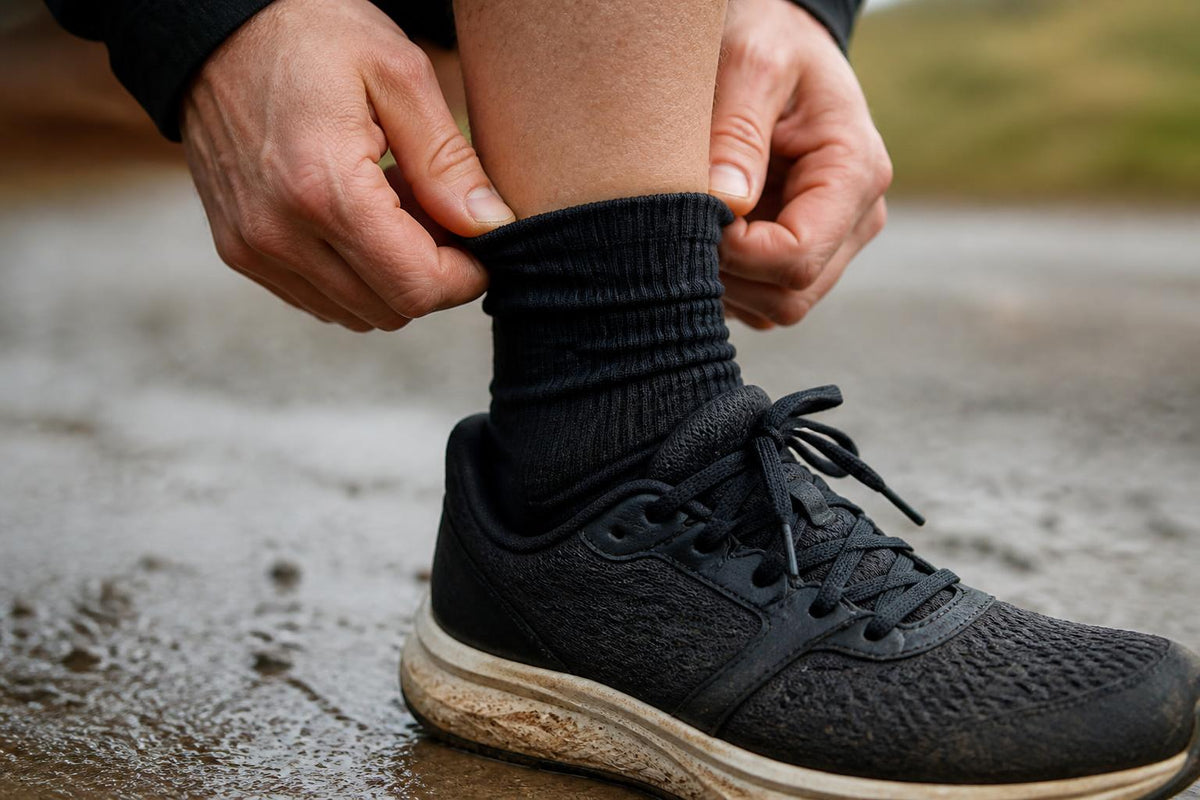
For most ordinary runs, longer socks are a simple comfort choice rather than a technical one. They give you more coverage, a bit more warmth on cool mornings, and a barrier between your skin and whatever the route throws at you, whether that is hedge cuttings on a towpath, grit on a winter pavement, or the edge of a tighter shoe collar. If you want one pair that can work across steady road miles, social runs, easy trail sections and a bit of cycling, long sports socks often make more sense than very low-cut pairs.
The key is not just length, but fit, fabric and how the sock works with the rest of your kit. A sock that creeps down, bunches at the toes or grips too tightly at the calf will ruin a run faster than a slightly heavier fabric ever will. When we choose socks for our own range and write our Field Notes, we look for everyday practicality first, because most runners are not chasing marginal gains. They want kit that feels right, washes well and gets used again next week.
What long sports socks actually do on an ordinary run
Longer socks cover more of the lower leg, but the benefit is more practical than dramatic. On a normal UK run, that extra coverage usually helps in four ways.
First, comfort. A longer sock can create a more settled feel around the ankle and lower calf, especially if you dislike the exposed gap between shoe and leggings, or between shoe and bare skin. Some runners simply feel more put together in a longer sock, and that matters more than marketing often admits. If your kit feels right, you are less likely to fiddle with it or cut a run short.
Second, coverage. This matters on pavements and paths alike. If you run near verges, canal paths, park edges or bridleways, longer socks help keep off grass seeds, light brambles, nettle contact and road grit flicked up in wet weather. They will not turn a road sock into protective trail gear, but they do reduce the small irritations that build up over an hour.
Third, warmth. In UK conditions, especially from autumn to spring, a little extra fabric over the ankle and lower calf can take the edge off a chilly start. That does not mean thick winter socks every time. Often a light or midweight longer sock is enough to stop that cold, exposed feeling without overheating once you settle into pace.
Fourth, skin protection. Some runners find that a shoe collar, ankle brace, timing chip strap, or even dried mud on leggings can rub. A longer sock gives you a soft layer between skin and equipment. If you cycle as well as run, the same pair may also suit cooler rides with bib shorts or tights, where that extra lower leg coverage feels useful without becoming bulky.
That is why many recreational runners end up preferring longer socks for everyday use. They are not trying to solve one dramatic problem. They are removing several small annoyances at once.
How a good fit should feel from toe to calf
The best running sock should be easy to forget about once you start moving. To judge that properly, work from the toe upward.
At the toes, the shape should match your foot well enough that fabric lies flat when your foot is fully inside the shoe. If the toe box of the sock is too short, you will feel pressure at the nail line. If it is too long, the spare fabric will wrinkle and rub. A flat toe seam is usually preferable for running, particularly if you are returning to the sport and your feet are not yet used to repeated impact.
Across the forefoot and arch, the sock should feel secure but not stretched to transparency. If you can see the fabric strain heavily before you have even started, the size is too small or the cut is too narrow for your foot. On the other hand, if the arch area can be pinched into loose folds, it is likely to move around in the shoe.
At the heel, check that the heel pocket sits where your heel actually is. If it rides up the Achilles or slips under the foot, the sizing is off. This is one of the quickest ways to spot a sock that looks fine in the hand but will not behave properly on the run.
Around the ankle and calf, the cuff should stay up without leaving a deep ridge in the skin. Some compression-style socks are intentionally firmer, but most everyday long sports socks should feel supportive rather than restrictive. If you take them off after a short wear and the cuff has left a very pronounced band, they may be too tight for regular training. That matters even more if you are wearing them for a commute, a lunch run and the walk home, not just a quick 5K.
In the shoe, pay attention to volume. A sock can fit your foot well but still be wrong for your trainers if it is too thick for the available space. Your foot should feel held, not squeezed. If your usual shoes already fit closely, a heavily cushioned sock may make the whole setup feel cramped and create pressure over the instep or toes.
One useful test is to put on the exact combination you plan to run in, socks, shoes and either shorts or leggings, then walk up and down stairs for a few minutes. If the cuff slides, the toe seam nags, or the shoe suddenly feels too tight, you have learned something before taking the tags off another pair.
If you are browsing our running socks for everyday training and mixed use, this is the standard we would use ourselves. Stay-up fit matters, but so does being able to wear the sock for the whole session without wishing you had chosen a softer or less fussy pair.
Which fabrics make sense in UK weather
Sock fabric matters most in changeable weather, which is to say, typical UK weather. You do not need a drawer full of specialist pairs, but it helps to know what different blends are good at.
Synthetic blends, usually based on polyester, polyamide or nylon with elastane, are the standard choice for many runners. They dry relatively quickly, hold shape well and are usually durable enough for repeated washing. For mild conditions and regular weekly running, these are often the most practical option. They also tend to cope better with repeated damp starts, puddles and routine laundry than very delicate natural fibres.
Cotton-rich socks are usually less suitable for running. They can feel soft at first, but once wet they hold moisture longer and may become heavy or rubby. For a short casual walk that might not matter. For a run, especially in drizzle or if your feet run warm, it usually does.
Merino blends can work very well in cool weather. They are often softer against the skin than people expect, and they manage temperature nicely on cold starts. A merino blend can also stay comfortable when slightly damp, which is useful in light rain or on frosty mornings when roads are wet but not flooded. The trade-off is that some merino-rich socks need a bit more care in washing, and durability can vary depending on the blend.
For wet conditions, the best answer is often not a magical waterproof fabric, but a sensible synthetic or wool blend that still feels decent once damp and dries again without going stiff. In ordinary UK rain, unless you are running through standing water, your socks are more likely to be dealing with spray, drizzle and general moisture than complete saturation.
Thickness matters as much as fibre. In cool weather, a midweight sock can be more comfortable than a very thin one, even if both use similar materials. In milder conditions, thinner socks usually feel less intrusive and dry quickly after washing. For many runners, the sweet spot is a medium-thin performance blend that can handle most of the year, plus one slightly warmer pair for winter.
If you use technical clothing elsewhere in your kit, such as a KYMIRA top or a lightweight base layer, keep the same practical mindset with socks. Match them to conditions, not claims. A sock that washes well, dries overnight and still feels good on the fourth outing of the week is usually the right one.
When longer socks are better than ankle socks
Ankle socks still suit plenty of runners, especially in warm weather and on straightforward road routes. But there are several situations where a longer sock is often the better choice.
For road running, longer socks are useful if you run early, late or through colder months. They close the gap between shoe and lower leg, and they can make a simple shorts-and-top setup feel more seasonally sensible without needing heavy kit.
For social runs, longer socks are often the easier option because they are less fussy. You are standing around before the start, chatting after the run, maybe heading for coffee. A sock that gives a little more warmth and coverage can be more comfortable across the whole outing, not just the running portion.
For winter training, they are usually the better call. Cold ankles and damp lower legs are not dangerous in themselves, but they can make the first twenty minutes less pleasant than they need to be. If a longer sock helps you get out the door consistently, that is a real benefit.
For mixed training sessions, such as a short run followed by mobility work, gym exercises or an indoor bike session, longer socks can bridge activities well. The same goes if you run to a class or club session and do not want to carry spare kit.
For cycling, many people prefer a longer sock because it pairs neatly with bib shorts, bib tights or close-fitting leggings. It can also reduce the exposed strip of skin that catches cool air. If your week includes both easy runs and casual rides, one versatile pair may cover more ground than a drawer split into highly specific categories.
That is one reason many customers browsing Fair Weather Runner start with longer socks when they want practical crossover kit. If you are not building an elite race wardrobe, versatility counts.
How to match socks with the rest of your kit
Sock choice becomes easier when you stop treating it as a separate technical problem. It is part of a kit system, and that system should be simple.
If you usually run in shorts, longer socks add useful coverage without forcing you into full leggings the moment temperatures drop. That works well for cool but not bitter mornings, especially when you warm up quickly once moving.
If you prefer leggings or fitted bottoms, think about where the hem sits. Some leggings overlap slightly with a longer sock, which can feel secure and warm. Others leave a small gap depending on your height and the cut. If you want a neater cold-weather setup, it is worth pairing your socks with leggings and bottoms for cooler runs and training rather than choosing each item in isolation.
Up top, keep the balance sensible. If your legs are covered with leggings and longer socks, you may only need a light top plus a base layer for cold starts and winter miles. If you are in shorts, a longer sock can do some of the work that full lower-body coverage would otherwise do, which keeps the whole outfit more flexible.
Gloves and headwear matter too. On many UK days, cold hands and ears are more noticeable than cold calves. So if you are deciding where to add warmth, do not overinvest in thick socks while neglecting gloves or a cap. A lighter long sock plus sensible accessories is often more comfortable than a heavy sock on its own.
Try not to overcomplicate colour matching or style rules. For ordinary recreational running, the main question is whether the pieces work together in use. Can you wear them for an easy 5K, a social 10K, a brisk walk to the start, and maybe a quick stop at the shop on the way home? If yes, you are buying well.
What to check before you buy your next pair
Before you buy, run through a short checklist.
Check the seam comfort. Look for a toe construction that is unlikely to rub, especially if you know you are sensitive across the front of the foot.
Check the thickness. Think about your actual shoes, not an imaginary future pair. If your current trainers are already snug, a bulky sock may be a mistake.
Check the cuff tension. You want enough hold to stop slippage, but not so much that the top band digs in after half an hour.
Check the likely use. Are these for winter road miles, mixed gym and run sessions, occasional cycling, or general weekly wear? Be honest. Most people need an everyday pair more than a highly specialised one.
Check wash care. If a sock needs delicate treatment you know you will not give it, it is not the right sock for your routine. Practical kit should survive ordinary life.
Check durability in the areas that matter, heel, forefoot and cuff. These are usually the first places to show wear.
Check shoe volume. This is easy to overlook online. A cushioned sock can be excellent, but only if your footwear has room for it. As a UK retailer operated by Fleeta Limited, we also keep this point in mind because not everyone buying socks from us is buying footwear from us at the same time, and we should not assume they are.
Finally, ask whether one pair can cover several activities. If you run, walk, train indoors and occasionally ride, a well-chosen longer sock may do all of that capably. That is often a better buy than a specialist pair that only comes out for one narrow use.
Long sports socks are not a miracle upgrade, and they do not need to be. For many runners, they are simply the easier, more comfortable choice for ordinary UK miles. If they fit properly, suit the weather, and work with the rest of your kit, you will notice them less, and enjoy your runs more.